
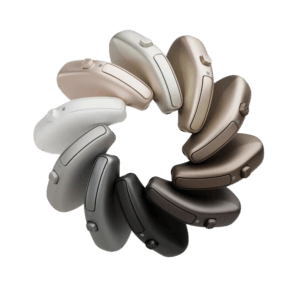
The 6 Different Types of Hearing Aids Available in 2026
If you are looking into hearing aids for the first time, or considering an upgrade, the range of options available in 2026 is genuinely impressive. Devices have become smaller, smarter, and better at handling the situations that matter most, particularly understanding speech in noisy environments.
But with that choice comes confusion. This guide breaks down the main styles available, what each one is suited to, and what the technology inside them can actually do.
The Two Main Categories
All hearing aids fall into one of two broad categories: Behind-the-Ear (BTE) or In-the-Ear (ITE). Within those two categories, there are several distinct styles, each with its own advantages depending on your level of hearing loss, lifestyle, and personal preference.
Behind-the-Ear (BTE)
The main unit sits behind the ear and connects to the ear canal via a thin tube and an earmould or soft dome. BTE hearing aids are the most powerful style available and can be fitted for mild through to profound hearing loss. They are also the easiest to handle and maintain, which makes them a good option for people who find small components fiddly.
BTE aids are the style most commonly provided by the NHS. They are durable, straightforward to clean, and available with rechargeable batteries.
Receiver-in-Canal (RIC)
Also known as Receiver-in-the-Ear (RITE), this style is similar to BTE but smaller. The main processor sits behind the ear, but the speaker (receiver) is positioned inside the ear canal on a thin wire rather than being housed in the main body. This produces a more natural sound and results in a noticeably smaller, more discreet device.
RIC hearing aids are currently the most popular style on the UK market. They are suitable for mild to severe hearing loss and are available in rechargeable versions with a full range of wireless connectivity features.
In 2026, the majority of the most advanced AI-powered hearing aids, including models from Phonak, Oticon, ReSound, and Signia, are available in RIC designs.
In-the-Ear (ITE)
ITE hearing aids are custom-moulded to fit inside the outer ear. No part of the device sits behind the ear. They are suitable for mild to moderately severe hearing loss and are a practical choice for people who prefer not to have anything resting behind their ear.
ITE aids are visible from the side but cannot be seen from behind. They are generally slightly larger than canal-style devices, which means they can accommodate more features and are easier to insert and remove.
In-the-Canal (ITC)
ITC hearing aids sit inside the ear canal itself, with only a small portion visible at the entrance of the ear. They are less visible than ITE aids but more limited in terms of power and features due to their smaller size. Suitable for mild to moderate hearing loss.
Rechargeable ITC options have expanded significantly in the past year. In February 2026, Unitron released their Insera R-S rechargeable ITC range, and Phonak’s Infinio Virto i90 ITC remains one of the most feature-rich canal devices currently available.
Completely-in-Canal (CIC)
CIC hearing aids fit fully inside the ear canal and are barely visible to others. They are discreet, lightweight, and benefit from a naturally reduced wind noise effect due to their position inside the ear. However, they are limited to mild to moderate hearing loss and have fewer features than larger devices. Their small size also means they can be more difficult to handle for people with reduced dexterity.
Invisible-in-Canal (IIC)
IIC hearing aids are the most discreet option currently available. They sit deep inside the ear canal and are effectively invisible during everyday wear. Because they sit closer to the eardrum, they can provide a more natural sound and directional awareness.
IIC devices are only suitable for mild to moderate hearing loss and are not rechargeable in most models. They require good ear canal anatomy to fit correctly and are custom-made for each individual.
What Has Changed in 2026?
The biggest shift in 2026 is the maturity of artificial intelligence inside hearing aids. This is no longer a marketing term; it is producing real, measurable improvements in how hearing aids handle noise.
Devices such as the Phonak Infinio Ultra Sphere, the Oticon Intent, and the ReSound Vivia Pro use deep neural network processing, trained on millions of real-world sound environments, to separate speech from background noise in a way that previous generations of devices could not manage. The result is less listening fatigue and better clarity in restaurants, social settings, and other challenging environments.
Other notable developments in 2026 include:
- Auracast compatibility, a new Bluetooth broadcast standard that allows hearing aids to receive audio directly from public venues such as cinemas, airports, and conference halls
- Health monitoring features including heart rate sensors in some models
- Increasingly compact rechargeable designs, with a 30-minute charge typically delivering two to three hours of use on most devices
- Widex released the Allure AI RIC RD in June 2026, adding a dedicated AI co-processor specifically for speech-in-noise processing
Which Style Is Right for You?
There is no single answer. The right hearing aid depends on your degree of hearing loss, your lifestyle, your dexterity, and your priorities around discretion, battery type, and connectivity.
What matters as much as the style is how the device is fitted. A well-fitted mid-range hearing aid will consistently outperform a premium device that has not been properly programmed to your individual hearing profile. Real Ear Measurement at the fitting appointment is the key to getting that right.
Frequently Asked Questions
Which hearing aid style is most popular in the UK?
Receiver-in-Canal (RIC) is currently the most popular style among private hearing aid users in the UK, offering a balance of discretion, sound quality, and available technology.
Can I get invisible hearing aids if I have severe hearing loss?
No. IIC and CIC devices are limited to mild to moderate hearing loss. For severe or profound hearing loss, BTE or RIC styles are the appropriate options.
Are rechargeable hearing aids reliable?
Yes. Rechargeable hearing aids are now standard across most styles and brands. Most models provide a full day of use on a single charge, typically 16 to 24 hours depending on usage.
What brands are available through The Ear Company?
I work with a range of leading manufacturers to find the right device for each individual. Book a hearing assessment to discuss which options are most suited to your specific hearing loss and lifestyle.
Book a Hearing Assessment in Leicestershire
If you are based in Loughborough, Mountsorrel, Hinckley, Coalville, or anywhere across Leicestershire and want to explore which hearing aid style is right for you, I offer home visit appointments across the area.
I am a fully qualified audiologist accredited by the British Society of Hearing Aid Audiologists (BSHAA) and registered with the Health and Care Professions Council (HCPC). All fittings include Real Ear Measurements as standard.
Call 07502 353946 or click here to book an appointment.